


OSPF (Open Shortest Path First) Protocol


OSPF Protocol (Open Shortest Path First) is a dynamic routing protocol used to exchange routing information between routers within a single autonomous system (AS). It is a link-state interior gateway protocol (IGP), standardized by the IETF in RFC 2328 for IPv4 and RFC 5340 for IPv6 (OSPFv3). Unlike older protocols like RIP, which rely on hop count, OSPF uses a more intelligent method based on network topology and link costs to determine the most efficient routing paths.
OSPF is designed for scalable and complex networks, especially in enterprise or service provider environments. It allows for hierarchical design using areas, where the core of the network is typically structured around a central backbone area (Area 0). By segmenting the network and using Link-State Advertisements (LSAs), OSPF routers maintain a synchronized and detailed map of the network, enabling fast and accurate routing decisions.
Its robust support for modern networking features like classless routing, authentication, and route summarization makes OSPF Protocol a preferred protocol in many professional networks. As a result, it plays a vital role in ensuring efficient, secure, and fault-tolerant data transmission across interconnected routers.
OSPF Protocol (Open Shortest Path First):
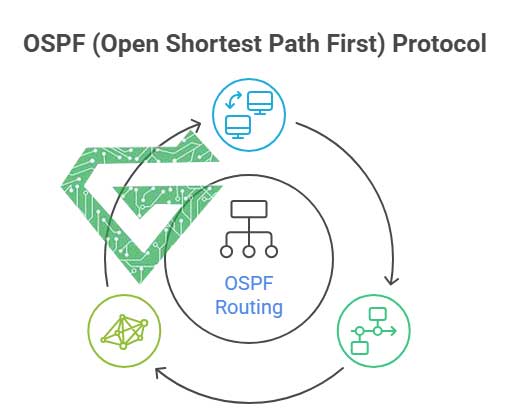
OSPF (Open Shortest Path First) is a link-state routing protocol used within large enterprise networks and autonomous systems. It’s a widely adopted interior gateway protocol (IGP) that enables routers to dynamically exchange routing information.
OSPF Protocol was developed as an alternative to the older RIP (Routing Information Protocol) and is designed to be more efficient and scalable. It uses the Dijkstra algorithm to calculate the shortest path to each destination and maintains a map of the entire network topology using Link-State Advertisements (LSAs).
Key Features of OSPF:
- Link-State Protocol: Every router has a complete map of the network.
- Uses Areas: To reduce overhead, large networks can be divided into areas (e.g., Area 0 is the backbone).
- Fast Convergence: Quickly adapts to network changes.
- Supports VLSM/CIDR: Efficient IP address usage.
- Authentication: Supports plain-text and MD5 authentication.
- Cost-Based Metric: Chooses routes based on bandwidth (lower cost = better route).
- Multicast Updates: Uses multicast (224.0.0.5 and 224.0.0.6) to reduce broadcast traffic.
- Hierarchical Design: Improves scalability and routing efficiency.
- Classless Protocol: Supports discontinuous networks.
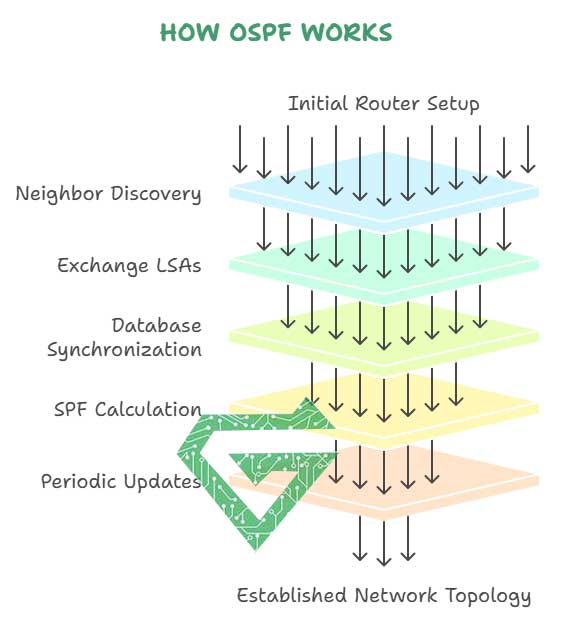
How OSPF works:
- Neighbor Discovery: Routers send Hello packets to discover and establish neighbor relationships.
- Exchange LSAs: Once neighbors are established, routers exchange Link-State Advertisements to learn the network topology.
- Database Synchronization: Routers maintain a Link-State Database (LSDB) containing all LSAs.
- SPF Calculation: Using Dijkstra’s algorithm, each router computes the Shortest Path First (SPF) tree and builds its routing table.
- Periodic Updates: Instead of sending full routing tables, only changes (LSAs) are propagated, reducing bandwidth use.
- Area Hierarchy: Routers within the same area have identical LSDBs. Routers between areas are called Area Border Routers (ABRs).
Advantages of OSPF:
OSPF offers several important advantages that make it well-suited for large and dynamic networks. One key benefit is that every router within the autonomous system maintains a complete and consistent view of the network’s topology. This enables routers to make precise routing decisions that can meet specific Quality of Service (QoS) criteria, which is especially useful in traffic engineering scenarios.
Another significant strength of OSPF Protocol is its ability to recalculate routes quickly in response to changes in the network. This leads to rapid convergence, meaning the network can quickly adapt to failures or topology updates without prolonged disruptions. This fast responsiveness makes OSPF ideal for large-scale or frequently changing environments, where downtime or delays are unacceptable.
Additionally, OSPF supports a hierarchical design by allowing the division of the network into multiple areas. This segmentation helps contain routing information within each area, reducing the size of each router’s link-state database and minimizing the amount of routing traffic. As a result, this improves scalability and reduces processing overhead across the network.
- Fast Convergence: Quickly detects changes and updates routes.
- Scalability: Suitable for large and complex networks due to area support.
- Efficient Routing: Cost-based metrics allow smarter routing decisions.
- Loop-Free: Built-in SPF algorithm prevents routing loops.
- Classless Support: Enables better IP addressing (supports VLSM/CIDR).
- Security Options: Authentication adds an extra layer of protection.
- Reduced Bandwidth Use: Sends only incremental updates.
Disadvantages of OSPF:
Despite its strengths, OSPF Protocol does have some limitations. Since it was originally designed for large and complex network environments and network equipment, it may not be the most efficient choice for smaller networks, where its advanced features can add unnecessary complexity.
Additionally, OSPF has a steeper learning curve and is generally more difficult to configure and manage than simpler protocols like RIP, making it less suitable for less experienced administrators or very basic setups.
- Complex Configuration: More difficult to configure and maintain than RIP.
- Higher Resource Usage: Requires more CPU and memory due to LSDB and SPF calculations.
- Challenging Troubleshooting: Debugging OSPF issues can be complex in large networks.
- Initial Learning Curve: Not as beginner-friendly for new network engineers.
Read more: What is BGP and Why Is It Critical for the Internet
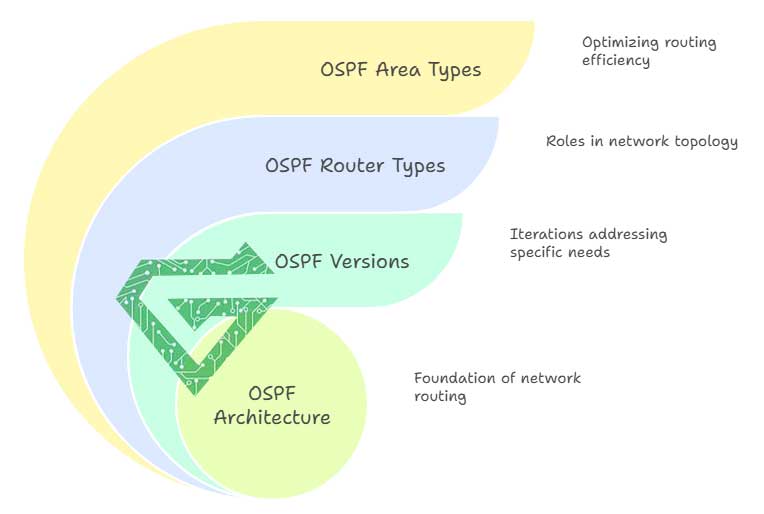
Different types of OSPF Protocol:
- OSPF Versions (Protocol Types)
OSPFv2
- Used for IPv4 networks.
- Defined in RFC 2328.
- Most common version in traditional enterprise networks.
OSPFv3
- Designed for IPv6 networks.
- Defined in RFC 5340.
- Supports multiple instances per link and better security using IPsec.
- Can also route IPv4 traffic with extensions (in modern implementations).
- OSPF Router Types
OSPF routers play different roles depending on where they are in the network:
Internal Router
- All interfaces are within the same OSPF area.
- Maintains a full link-state database for that area only.
Backbone Router
- Located in Area 0 (Backbone Area).
- Can be internal to Area 0 or also serve as a border router.
Area Border Router (ABR)
- Connects Area 0 to other areas.
- Maintains separate LSDBs for each area it connects to.
- Summarizes and redistributes routing information between areas.
Autonomous System Boundary Router (ASBR)
- Connects the OSPF Protocol network to external routing domains (e.g., BGP, RIP).
- Injects external routes into OSPF using Type 5 or Type 7 LSAs.
- OSPF Area Types
To control route advertisement and database size, OSPF defines several area types:
Backbone Area (Area 0)
- Central area through which all other areas must connect.
- Core of an OSPF network.
Standard (Normal) Area
- Can receive and forward all LSAs.
- No restrictions on route types.
Stub Area
- Blocks external routes (Type 5 LSAs).
- Uses a default route to reach external networks.
- Reduces database size and routing overhead.
Totally Stubby Area (Cisco Proprietary)
- Blocks external routes and inter-area routes.
- Only default route is allowed.
- More restrictive than a stub area.
Not-So-Stubby Area (NSSA)
- Similar to a stub, but allows limited external routes (Type 7 LSAs).
- Used when an ASBR is inside a stub area.
Totally NSSA
- Most restrictive NSSA; blocks all external and inter-area routes, except for a default route.
- Only allows Type 7 LSAs from the ASBR within the NSSA.
Devices That Support OSPF:
The OSPF protocol is widely supported and is implemented in many types of networking devices especially those used in enterprise and service provider environments. Here’s an overview of the devices that typically support OSPF Protocol:
- Routers
- Enterprise Routers All major vendors (like Cisco, Juniper, Huawei, HP, MikroTik, etc.) support OSPF Protocol in their enterprise-grade routers.
- Service Provider Routers High-end carrier-class routers used by ISPs almost always support advanced OSPF features for large-scale networks.
- Layer 3 Switches
- Many Layer3 (multilayer) switches can run OSPF because they support routing functions in addition to switching.
- Common in enterprise LANs where routing between VLANs and subnets is required.
- Firewalls
- Next-generation firewalls (NGFWs) from vendors like Fortinet, Cisco (Firepower), Palo Alto Networks, and Check Point often support OSPF Protocol for dynamic routing.
- Useful in environments where firewalls are used as edge or internal gateways.
- Virtual Routers / Software Routers
- Virtual network appliances or software routers like pfSense, VyOS, MikroTik (RouterOS), and FRRouting support OSPF.
- Often used in virtualized or cloud-based networking environments.
- SDN Controllers and Network Virtualization Platforms
- Modern Software-Defined Networking (SDN) solutions and network virtualization platforms (like VMware NSX) can integrate OSPF to maintain compatibility with traditional routing infrastructure.
Conclusion:
OSPF is a powerful and widely-used interior gateway protocol (IGP) designed for use within large enterprise networks. As a link-state routing protocol, it provides fast convergence, scalability and efficient routing through the use of Dijkstra’s algorithm. By organizing routers into areas, OSPF reduces routing overhead and improves network performance.
Its key advantages include support for Variable Length Subnet Masking (VLSM), equal-cost multipath routing (ECMP), and route summarization. OSPF Protocol also allows for clear hierarchy and better control over routing updates, making it ideal for complex network topologies. In summary, OSPF Protocol remains a robust and reliable choice for dynamic routing within large-scale IP networks, offering high efficiency, stability, and scalability.