


What is Cisco Switch


Before everything, we need to talk about network and what does switch do in network?? Well, when you buy a new computer, you will probably try to connect to Internet. For doing this, You have to establish to your router, which can receive data from Internet and forward it to the computer.
Now imagine, there are some computers and you want to connect them together. In this situation you need a switch network. Cisco is a popular company, that produces a lot of network equipment, especially network switch. We want to explain this supernatural product in this article.
What is Cisco Switch:
Switches are main key structure for any network. They connect multiple devices, such as computers, access points, printers, and servers, etc. A switch enables connected devices to share information and talk to each other in the same network of a building or environment. Switches assist sharing of resources by connecting devices together. In small business network, you can connect devices together in addition, you can talk to each other, either. If there isn’t switch in your small business, you can’t build it.
There are two kinds of switches: managed and unmanaged, We will talk about them during of this context.
Managed switches:
These switches give you more security, more features also more flexibility. you can configure your network yourself. With this superb control, you can better protect your network and improve the quality of service (QOS) for those who access the network. All switches within the 2960-X, 3850-X, 4500-X, and 6800-X series are managed.
Unmanaged switches:
An unmanaged network switch doesn’t need to configure, they have designed for simply plug. We use them for basic connectivity more such as home network or whenever just a few more ports need, like in a lab or conference room.
When you build a small office network, two essential pieces of equipment you will need are switches and routers. Most of people think they are same but their switch performances are completely different. Although they look similar, functions of them within network aren’t.
Read more: What is cisco router
Different types of cisco switch:
Cisco produces a variety of switches specifically designed for different functions. Cisco designs the Catalyst switches for campus networks and Nexus switches for data centers. Some features of Catalyst switches are new capabilities, higher performance, higher density, and lower cost.
There are a lot of types of Cisco Network switches that provide by cisco company, include:
- Blade Switches
- Campus LAN Switches-Access
- Campus LAN Switches-Compact
- Campus LAN Switches-Core and Distribution
- Data Center Switches
- Data Center Network Management
- LAN Network Management
- LAN Switches-Small Business
- Virtual Networking
- Cloud Networking Services
1.Blade switches
The Dell M1000E Blade platform with the high switch performance Cisco InfiniBand switches provides greater productivity and reduces total cost of ownership for high performance clusters by providing low latency and high throughput blade switch solution.
The Cisco SFS M7000E Switch supports dual-speed, 4x double data rate (DDR) and single data rate (SDR) interfaces that deliver 20Gbps and 10 Gbps respectively, per port. The low latency and high bandwidth offered by the Cisco SFS M7000E InfiniBand Switch enables the Dell M1000E blade platform to host the most demanding distributed applications and helps deliver competitive advantage for customers. Some performance of Blade switches;
- Reducing cable complexity
- Using space more effectively
- Using energy resources more efficiently
- Providing higher availability and flexibility
2.Campus LAN Switches-Access
Types of Cisco switch includes; cisco catalyst 9400 series Switches (modular access), cisco catalyst 9300 series Switches, cisco catalyst 9200 series Switches, cisco catalyst 1300 series Switches, cisco catalyst 1200 series managed Switches, cisco catalyst 1000 series Switches, cisco catalyst PON series, cisco Meraki Cloud Managed Switches.
Cisco catalyst 9300 series Switches:
Types of Cisco switch alone includes several models; Catalyst 9300 multigigabit 90W PoE models, Catalyst 9300X fiber models, Catalyst 9300 high-performance models, Catalyst 9300 90W PoE models, Catalyst 9300 60W PoE models, Catalyst 9300 1G models, Catalyst 9300L models, Catalyst 9300LM models. These models follow these features that explain them.
Read more: Comparing Managed and Unmanaged Switches
Catalyst 9300 multigigabit 90W PoE models:
– 48-port 10G, multigigabit, 90W PoE
- C9300X-48HX. Built for secure Wi-Fi 6/6E high-speed access and beyond, with 90W PoE for Cisco smart building deployments.
- 48-port 10GBASE-T, 10G/5G/2.5G/1G/100M multigigabit.
- Based on Cisco UADP 2.0sec ASIC, with 100G hardware-based IPsec.
- Orderable with Meraki cloud-management experience.
-48-port 10G, multigigabit, data
- C9300X-48TX. Built for secure Wi-Fi 6/6E high-speed access and beyond.
- 48-port 10GBASE-T, 10G/5G/2.5G/1G/100M multigigabit, data only.
- Based on Cisco UADP 2.0sec ASIC, with 100G hardware-based IPsec.
- Orderable with Meraki cloud-management experience.
-40-port 5G, 8-port 10G, multigigabit, 90W PoE
- C9300X-48HXN. Built for secure Wi-Fi 6/6E high-speed access and beyond, with 90W PoE for Cisco smart building deployments.
- 40-port 5G/2.5G/1G/100M multigigabit, 8-port 10GBASE-T, 10G/5G/2.5G/1G/100M multigigabit.
- Based on Cisco UADP 2.0sec ASIC, with 100G hardware-based IPsec.
- Orderable with Meraki cloud-management experience.
-24-port 10G, multigigabit, 90W PoE
- C9300X-24HX. Built for secure Wi-Fi 6/6E high-speed access and beyond, with 90W PoE for Cisco smart building deployments.
- 24-port 10GBASE-T, 10G/5G/2.5G/1G multigigabit, 1000M/100M.
- Based on Cisco UADP 2.0sec ASIC, with 100G hardware-based IPsec.
- Orderable with Meraki cloud-management experience.
Catalyst 9300X fiber models:
-24-port 25G fiber
- C9300X-24Y. Higher density fiber models for campus access and distribution.
- 24-port 25G/10G/1G (SFP28). Based on Cisco UADP 2.0sec ASIC, with 100G hardware-based IPsec.
- Orderable with Meraki cloud-management experience.-
-12-port 25G fiber
- C9300X-12Y-A. 25G fiber models for campus access and branch. 12-port 25G/10G/1G (SFP28).
- Based on Cisco UADP 2.0sec ASIC, with 100G hardware-based IPsec.
- Orderable with Meraki cloud-management experience.
Catalyst 9300 high-performance models:
-48-port 1G, 60W PoE, high performance
- C9300-48UB. Built with double buffers, MAC and IP scale, and higher access control list (ACL) scale.
- 48-port 1G/100M/10M, 60W PoE.
- Based on Cisco UADP 2.0XL ASIC.
-24-port 5G multigigabit, 60W PoE, high performance
- C9300-24UXB. Built with double buffers, MAC and IP scale, and higher access control list (ACL) scale.
- 24-port 5G/2.5G/1G/100M multigigabit, 60W PoE.
- Based on Cisco UADP 2.0XL ASIC.
-24-port 1G, 60W PoE, high performance
- C9300-24UB. Built with double buffers, MAC and IP scale, and higher access control list (ACL) scale.
- 24-port 1G/100M/10M, 60W PoE.
- Based on Cisco UADP 2.0XL ASIC.
Catalyst 9300 90W PoE models:
-24-port 1G, 90W PoE
- C9300-24H. Optimized for wired and wireless converged access, with 24-port 1G/100M, 90W PoE.
- 40G, 25G, 10G, 1G fiber and 10G multigigabit copper modular uplink options.
- Based on Cisco UADP 2.0 ASIC.
-48-port 1G, 90W PoE
- C9300-48H. Optimized for wired and wireless converged access, with 48-port 1G/100M, 90W PoE.
- 40G, 25G, 10G, 1G fiber and 10G multigigabit copper modular uplink options.
- Based on Cisco UADP 2.0 ASIC.
Catalyst 9300 60W PoE models:
-24/48-port 1G, 60W PoE
- C9300-24U, C9300-48U. Optimized for wired and wireless converged access, with 24- and 48-port 1G/100M, 60W PoE.
- 40G, 25G, 10G, 1G fiber and 10G multigigabit copper modular uplink options.
- Based on Cisco UADP 2.0 ASIC. Orderable with Meraki cloud-management experience.
-24-port 10G, multigigabit, 60W PoE
- C9300-24UX. Built for secure Wi-Fi 6/6E high-speed access and beyond.
- 24-port 10GBASE-T, 10G/5G/2.5G/1G/100M multigigabit, 60W PoE. 40G, 25G, 10G, 1G fiber and 10G multigigabit copper modular uplink options.
- Based on Cisco UADP 2.0 ASIC.
- Orderable with Meraki cloud-management experience.
-36-port 2.5G, 12-port 10G, multigigabit, 60W PoE
- C9300-48UXM. Built for secure Wi-Fi 6/6E high-speed access.
- 36-port 2.5G/1G/100M multigigabit, 12-port 10GBASE-T, 10G/5G/2.5G/1G/100M multigigabit, 60W PoE.
- 40G, 25G, 10G, 1G fiber and 10G multigigabit copper modular uplink options.
- Based on Cisco UADP 2.0 ASIC.
- Orderable with Meraki cloud-management experience.
-48-port 5G multigigabit
- C9300-48UN. Built for secure Wi-Fi 6/6E high-speed access.
- 48-port 5G/2.5G/1G/100M multigigabit, 60W PoE. 40G, 25G, 10G, 1G fiber and 10G multigigabit copper modular uplink options.
- Based on Cisco UADP 2.0 ASIC.
- Orderable with Meraki cloud-management experience.
Catalyst 9300 1G models:
-24/48-port 1G copper, data only
- C9300-24T, C9300-48T. 24- and 48-port 1G/100M copper, data only.
- 40G, 25G, 10G, 1G fiber and 10G multigigabit copper modular uplink options.
- Based on Cisco UADP 2.0 ASIC.
- Orderable with Meraki cloud-management experience.
-24/48-port 1G SFP
- C9300-24S, C9300-48S. 24- and 48-port 1G SFP.
- 40G, 25G, 10G, 1G fiber and 10G multigigabit copper modular uplink options.
- Based on Cisco UADP 2.0 ASIC.
- Orderable with Meraki cloud-management experience.
-24/48-port 1G copper, 30W PoE
- C9300-24P, C9300-48P. 24- and 48-port 1G/100M copper, 30W PoE.
- 40G, 25G, 10G, 1G fiber and 10G multigigabit copper modular uplink options.
- Based on Cisco UADP 2.0 ASIC.
- Orderable with Meraki cloud-management experience.
Catalyst 9300L models:
-24/48-port 1G copper, data only
- C9300L-24T-xx, C9300L-48T-xx. 24- and 48-port 1G/100M copper, data only.
- Four 10G (-4X) or 1G (-4G) fixed fiber uplink options.
- Based on Cisco UADP 2.0 ASIC.
- The 10G uplink models are orderable with Meraki cloud-management experience.
48-port 1G copper, full 30W PoE
- C9300L-48PF-4X, C9300L-48PF-4G.
- 48-port 1G/100M copper, 30W PoE. Four 10G (-4X) or 1G (-4G) fixed fiber uplink options.
- Based on Cisco UADP 2.0 ASIC. The 10G uplink models are orderable with Meraki cloud-management experience.
-48-port 1G copper, 60W PoE, 12-port multigigabit
- C9300L-48UXG-4X, C9300L-48UXG-2Q.
- 48-port 60W PoE, 12-port 10GBASE-T, 10G/5G/2.5G/1G/100M multigigabit, 36-port 1G.
- Four 10G (-4X) or two 40G (-2Q) fixed fiber uplink options. Based on Cisco UADP 2.0 ASIC.
- The 10G uplink models are orderable with Meraki cloud-management experience.
-48-port 1G copper, 60W PoE, 8-port multigigabit
- C9300L-48UX-4Y. 48-port 60W PoE, 8-port 10GBASE-T, 10G/5G/2.5G/1G/100M multigigabit, 40-port 1G.
- Two 25G fixed fiber uplinks. Based on Cisco UADP 2.0 ASIC.
-24-port 1G copper, 60W PoE, 8-port multigigabit
- C9300L-24UXG-4X, C9300L-24UXG-2Q.
- 24-port 60W PoE, 8-port 10GBASE-T, 10G/5G/2.5G/1G/100M multigigabit, 16-port 1G.
- Four 10G (-4X) or two 40G (-2Q) fixed fiber uplink options.
- Based on Cisco UADP 2.0 ASIC.
- The 10G uplink models are orderable with Meraki cloud-management experience.
-24/48-port 1G copper, 30W PoE
- C9300L-24P-xx, C9300L-48P-xx. 24- and 48-port 1G/100M copper, 30W PoE. Four 10G (-4X) or 1G (-4G) fixed fiber uplink options.
- Based on Cisco UADP 2.0 ASIC.
- The 10G uplink models are orderable with Meraki cloud-management experience.
Catalyst 9300LM models:
-48-port 1G copper, 60W PoE, 8-port 10G, multigigabit
- C9300LM-48UX-4Y. Shallow depth chassis.
- 48-port 60W PoE, 8-port 10GBASE-T, 10G/5G/2.5G/1G/100M multigigabit, 40-port 1G. Four 25G fixed fiber uplinks.
- Based on Cisco UADP 2.0 ASIC.
-24/48-port 1G copper, 60W PoE
- C9300LM-24U-4Y, C9300LM-48U-4Y.
- Shallow depth chassis. 24- and 48-port 1G/100M copper, 60W PoE.
- Four 25G fixed fiber uplinks.
- Based on Cisco UADP 2.0 ASIC.
48-port 1G copper, data only
- C9300LM-48T-4Y. Shallow depth chassis.
- 48-port 1G/100M copper, data only.
- Four 25G fixed fiber uplinks.
- Based on Cisco UADP 2.0 ASIC.
Cisco catalyst 9200 series Switches:
Type of Cisco switch of this series alone includes several models; Catalyst 9200 multigigabit, PoE+ models, Catalyst 9200 PoE+ models, Catalyst 9200 data models, Catalyst 9200L multigigabit, PoE+ models, Catalyst 9200L PoE+ models, Catalyst 9200L data models, Catalyst 9200CX compact models.
Catalyst 9200 multigigabit, PoE+ models:
-24-port 1G, multigigabit, 30W PoE+
- C9200-24PXG. Optimized for Wi-Fi 6/6E wired and wireless converged access and higher-bandwidth branch deployments.
- 16-port 1G, 8-port 10GBASE-T, 10G/5G/2.5G/1G multigigabit, 1000M/100M.
- Modular uplinks of 40G, 25G, 1G, or 10G/1G.
- Stackable to 160G, FRU power supplies and fans.
-48-port 1G, multigigabit, 30W PoE+
- C9200-48PXG. Optimized for Wi-Fi 6/6E wired and wireless converged access and higher-bandwidth branch deployments.
- 40-port 1G, 8-port 10GBASE-T, 10G/5G/2.5G/1G multigigabit, 1000M/100M.
- Modular uplinks of 40G, 25G, 1G, or 10G/1G.
- Stackable to 160G, FRU power supplies and fans.
Catalyst 9200 PoE+ models:
-24-port 1G, 30W PoE+, enhanced VN
- C9200-24PB. Ideal for improved Cisco SD-Access deployments. 24-port 1G, 30W PoE+.
- Modular uplinks of 40G, 25G, 1G, or 10G/1G. Stackable to 160G, FRU power supplies and fans.
-48-port 1G, 30W PoE+, enhanced VN
- C9200-48PB. Ideal for improved Cisco SD-Access deployments.
- 48-port 1G, 30W PoE+.
- Modular uplinks of 40G, 25G, 1G, or 10G/1G.
- Stackable to 160G, FRU power supplies and fans.
-24-port 1G, 30W full PoE+
- C9200-24P. Ideal for secure branch and entry-level enterprise environments.
- 24-port 1G, 30W PoE+.
- Modular uplinks of 25G, 10G, or 1G.
- Stackable to 80G, FRU power supplies and fans.
-48-port 1G, 30W full PoE+
- C9200-48P. Ideal for secure branch and entry-level enterprise environments.
- 48-port 1G, 30W PoE+.
- Modular uplinks of 25G, 10G, or 1G.
- Stackable to 80G, FRU power supplies and fans.
-48-port 1G, 30W partial PoE+
- C9200-48PL. Ideal for secure branch and entry-level enterprise environments.
- 48-port 1G, 30W partial PoE+.
- Modular uplinks of 25G, 10G, or 1G.
- Stackable to 80G, FRU power supplies and fans.
Catalyst 9200 data models:
-24-port 1G, data
- C9200-24T. Ideal for secure branch and entry-level enterprise environments.
- 24-port 1G, data.
- Modular uplinks of 25G, 10G, or 1G.
- Stackable to 80G, FRU power supplies and fans.
-48-port 1G, data
- C9200-48T. Ideal for secure branch and entry-level enterprise environments.
- 48-port 1G, data.
- Modular uplinks of 25G, 10G, or 1G.
- Stackable to 80G, FRU power supplies and fans.
Catalyst 9200L multigigabit, PoE+ models:
-24-port 1G, multigigabit, 30W PoE+
- C9200L-24PXG-2Y. C9200L-24PXG-4X. Designed for branch wired and wireless converged access.
- 16-port 1G, 8-port 10GBASE-T, 10G/5G/2.5G/1G multigigabit, 1000M/100M.
- Two 25G/10G/1G fixed uplinks or four 10G/1G fixed uplinks.
- Stackable to 160G, FRU power supplies and fixed redundant fans.
-48-port 1G, multigigabit, 30W PoE+
- C9200L-48PXG-2Y. Optimized for Wi-Fi 6/6E wired and wireless converged access and higher-bandwidth branch deployments.
- 40-port 1G, 8-port 10GBASE-T, 10G/5G/2.5G/1G multigigabit, 1000M/100M. Two 25G/10G/1G fixed uplinks or four 10G/1G fixed uplinks.
- Stackable to 160G, FRU power supplies and fixed redundant fans.
Catalyst 9200L PoE+ models:
-24-port 1G, 30W full PoE+
- C9200L-24P-4G. C9200L-24P-4X.
- Cost-effective foundation for small and branch networks. 24-port 1G, 30W PoE+.
- Four 1G or 10G/1G fixed uplinks.
- Stackable to 80G, FRU power supplies and fixed redundant fans.
-48-port 1G, 30W partial PoE+
- C9200L-48PL-4G. C9200L-48PL-4X.
- Cost-effective foundation for small and branch networks. 48-port 1G, partial 30W PoE+.
- Four 1G or 10G/1G fixed uplinks.
- Stackable to 80G, FRU power supplies and fixed redundant fans.
-48-port 1G, 30W full PoE+
- C9200L-48P-4G. C9200L-48P-4X.
- Cost-effective foundation for small and branch networks. 48-port 1G, 30W PoE+.
- Four 1G or 10G/1G fixed uplinks.
- Stackable to 80G, FRU power supplies and fixed redundant fans.
Catalyst 9200L data models:
-24-port 1G, data
- C9200L-24T-4G. C9200L-24T-4X.
- Cost-effective foundation for small and branch networks. 24-port 1G, data.
- Four 1G or 10G/1G fixed uplinks.
- Stackable to 80G, FRU power supplies and fixed redundant fans.
48-port 1G, data
- C9200L-48T-4G. C9200L-48T-4X.
- Cost-effective foundation for small and branch networks. 48-port 1G, data.
- Four 1G or 10G/1G fixed uplinks.
- Stackable to 80G, FRU power supplies and fixed redundant fans.
Catalyst 9200CX compact models:
8-port 1G, multigigabit, 60W UPOE
- C9200CX-8UXG-2X. C9200CX-8UXG-2XH.
- Ideal for use in limited spaces and smart buildings.
- 4-port 1G, 4-port multigigabit, 60W UPOE. Two 10G SFP+ fixed uplinks. AC or AC/DC options.
- Compact and fanless.
-12-port 1G, 30W PoE+
- C9200CX-12P-2X2G. C9200CX-12P-2XGH.
- Ideal for use in limited spaces and smart buildings. 12-port 1G, 30W PoE+.
- Two 1G copper, two 10G SFP+ fixed uplinks. AC or AC/DC options.
- Compact and fanless.
-12-port 1G, data
- C9200CX-12T-2X2G. Ideal for use in limited spaces and smart buildings.
- 12-port 1G, data. Two 1G copper, one 1G CU PD, two 10G SFP+ fixed uplinks.
- PoE powered or optional auxiliary 80W AC or DC power adaptor.
- Compact and fanless
-8-port 1G, 30W PoE+
- C9200CX-8P-2X2G. C9200CX-8P-2XGH.
- Ideal for use in limited spaces and smart buildings. 8-port 1G, 30W PoE+.
- Two 1G copper, two 10G SFP+ fixed uplinks.
- AC or AC/DC options.
- Compact and fanless.
Read more: What is PoE and all about it
Cisco Catalyst 1300 Series Switches:
Cisco Catalyst 1300 Series Switches provide simplicity, flexibility, and security for small and medium-sized business (SMB) networks. With an intuitive dashboard, advanced features, and pervasive security, these managed access switches are positioned to accelerate your digital transformation.
Cisco Catalyst 1200 Series Switches:
Cisco Catalyst 1200 Series Switches are the latest in affordable smart switches that combine powerful network performance, simplified management, and reliability with a comprehensive suite of network features that you need for a solid small business network.
Cisco Catalyst 1000 Series Switches:
Cisco Catalyst 1000 Series switches provide enterprise-grade network access sized for small businesses. With a wide range of Power over Ethernet (PoE) and port combinations, these easy-to-manage and provide the switch performance in a modern small office needs.
Cisco Catalyst PON Series:
With enterprise-grade features such as power and uplink redundancy, Power over Ethernet (PoE+) and simple, low-cost operations, the Cisco Catalyst PON Series gives you what you need today, in a simple, safe, and cost-effective GPON solution.
Cisco Meraki Cloud Managed Switches:
Scale without complexity. Extend reliable connectivity and robust security anywhere with the new cloud-managed Meraki switches.
- More with less: The cost-effective Meraki MS130 boosts switch performance with multigigabit capacity, powerful security, and smart power management
- When simplification and functionality meet: the cloud-managed Catalyst 9300-M switches unleash operational excellence from day 0
- One dashboard, any environment: Seamlessly extend reliable, secure connectivity to hot/cold/tight spaces with the MS130R ruggedized switch
3.Campus LAN Switches-Compact
Types of Cisco switch of this series includes two types; Cisco Catalyst Building Series Switches, Cisco Catalyst Micro Switches.
Cisco Catalyst Digital Building Series Switches:
Make your building smarter. Save on energy costs and enhance flexibility, safety, and productivity. Our Catalyst Digital Building plenum-rated UPOE fan-less switches are designed for smart buildings and optimized for low-voltage PoE. Combine lighting, air conditioning, security systems, and more on one IP network with seamless security and easy installation and management.
Cisco Catalyst Micro Switches:
Just what you need, right where you need it. Offering enterprise-class security, management and reliability, Catalyst Micro Switches are optimized for smart buildings and fiber-to-the-office (FTTO) networks. They’re the smart choice for delivering copper or fiber connectivity directly to the end device.
4.Campus LAN Switches–Core and Distribution:
Type of Cisco switch of this series includes three types; Cisco Catalyst 9600 Series Switches, Cisco Catalyst 9500 Series Switches, Cisco Nexus 7000 Series Switches.
Cisco Catalyst 9600 Series Switches:
Types of Cisco switch of thus series includes Chassis, Supervisor engines, Catalyst 9600X fiber line cards and Catalyst 9600 line cards.
Chassis
- C9606R. Modular core for resilience at scale, plus comprehensive security.
- 25.6 Tbps switching capacity, 6.4 Tbps per slot supporting 400G to 10G multigigabit
- Supervisor engines
-4 Tbps/slot supervisor, 400G QSFP-DD
- C9600X-SUP-2. Made for secure and highly available high-speed campus core deployments.
- Based on Cisco Silicone One Q200 ASIC, supports up to 6.4 Tbps per slot, up to 400G QSFP-DD, and 50G SFP56.
-4 Tbps/slot supervisor, 100G/25G
- C9600-SUP-1. Designed to reimagine connections, reinforce security, and redefine the hybrid workplace.
- Based on Cisco UADP 3.0 ASIC, supports up to 2.4 Tbps per slot, up to 100G QSFP28, and 25G SFP28.
Catalyst 9600X fiber line cards:
-30-port 100G/40G QSFP28 with 400G/200G/100G QSFP-DD fiber
- C9600X-LC-32CD.
- High-density fiber line cards for campus core.
- 30-port 100G/40G (QSFP28) and 2-port 400G/200G/100G (QSFP-DD).
- Up to 128 ports, non-blocking.
- C9600X-SUP-2 only.
-56-port 50G/25G/10G SFP56 with 100G QSFP28 fiber
- C9600X-LC-56YL4C. High-density fiber line cards for campus core and distribution.
- 56-port 50G/25G/10G (SFP56) and 4-port 100G (QSFP28).
- Up to 240 ports, non-blocking. C9600X-SUP-2 only.
-40-port 50G/25G/10G SFP56 with 400G QSFP-DD, 200G QSFP56 fiber
- C9600-LC-40YL4CD. High-density fiber line cards for campus core and distribution.
- 40-port 50G/25G/10G (SFP56) and 2-port 400G (QSFP-DD) and 2-port 200G (QSFP56) with C9600X-SUP-2.
- 40-port 25G/10G (SFP28) and 2-port 100G/40G (QSFP28) with C9600-SUP-1.
Catalyst 9600 line cards:
-24-port 100G/40G QSFP56 fiber
- C9600-LC-24C. Higher-density fiber line cards for evolving campus core.
- 24-port 100G/40G (QSFP28) with C9600X-SUP-2.
- 24-port 40G (QSFP+) or 12-port 100G (QSFP28) with C9600-SUP-1.
-48-port 10G multigigabit copper
- C9600-LC-48TX. High-density copper line cards for campus distribution.
- Built for secure Wi-Fi 6/6E and high-speed access. 48-port 10G with C9600X-SUP-2.
- 48-port 10G/5G/2.5G/1G multigigabit with C9600-SUP-1.
-48-port 50G/25G/10G SFP56 fiber
- C9600-LC-48YL. High-density 50G/25G fiber line cards for campus core and distribution.
- 48-port 50G/25G/10G (SFP56) with C9600X-SUP-2.
- 48-port 25G/10G/1G (SFP56) with C9600-SUP-1.
-48-port 1G SFP fiber
- C9600-LC-48S. High-density 1G (SFP) fiber line cards for campus distribution. C9600-SUP-1 only.
- *Cisco Catalyst 9500 Series Switches: With security and insights built in, these fixed-core enterprise switches make networking simple.
- Follow different type of this series with us; Catalyst 9500X models and Catalyst 9500 high performance models.
Catalyst 9500X models:
-28-ports 100G, 8-ports 400G fiber
- C9500X-28C8D. High-density fiber models for campus core and distribution.
- 28-port 100G/40G (QSFP28) and 8-port 400G/200G/100G (QSFP-DD).
- Based on Cisco Silicon One Q200 ASIC.
-60-ports 50G, 4-ports 400G fiber
- C9500X-60L4D. High-density fiber models for campus distribution.
- 60-port 50G/25G (SFP56) and 4-port 400G/200G/100G (QSFP-DD).
- Based on Cisco Silicon One Q200 ASIC.
Cisco Nexus 7000 Series Switches:
Create the network foundation for a next-generation Unified Fabric data center. The modular Cisco Nexus 7000 and 7700 switches deliver a comprehensive Cisco NX-OS feature set and open-source programmable tools for software-defined networking (SDN) deployments. They offer high-density 10, 40, and 100 Gigabit Ethernet with application awareness and performance analytics. This series includes two types; Nexus 7000 Switches and Nexus 7700 switches.
Nexus 7000 Switches
- 4, 9, 10, and 18 slots
- 550 Gbps bandwidth per slot
- Up to 192 40 GE ports and 32 100 GE ports
- Redundant supervisors
Nexus 7700 switches
- 2, 6, 10, and 18 slots
- Upto 2.8Tbps bandwidth per slot
- Up to 480 40GE and 480 100GE ports
- Redundant supervisors
Read more: Introducing Cisco IOS
5.Datacenter Switches
Types of Cisco switch of this series includes five types; Cisco Nexus 9000 Series Switches, Cisco Nexus 7000 Series Switches, Cisco Nexus 3550 Series, Cisco Nexus 3000 Series Switches and Cisco Nexus 2000 Series fabric Extenders.
Cisco Nexus 9000 Series Switches:
Built on Cisco silicon, the Cisco Nexus 9000 Series delivers industry-leading data center performance from the inside out. 400G ports for heavy lifting and For data requirements big or small, multispeed ports have your back with full backward compatibility. They can flex and scale with you, while you handle the growth.
Seeing is securing Toughen, tighten, and protect your network with streaming telemetry, advanced analytics, and line-rate encryption (MACsec).
Reduce operational costs with unified ports supporting 10/25G Ethernet and 8/16/32G Fibre Channel, RDMA over converged Ethernet (RoCE), and IP storage.
Dial in performance with intelligent buffers and zero packet drop for 50 percent faster application completion time.
Nexus 9200 Series switches: Dense, high-capacity spine and leaf supporting 800G for massively scaled-out fabrics.
Nexus 9300 Series switches: If spine and leaf or top-of-rack are your style, these fixed switches support ports from 1G to 400G.
Nexus 9400 Series switches: High bandwidth, small form factor. This compact modular system supports 400G speeds in a 4 RU platform.
Nexus 9500 Series switches: Enterprise or high growth? Modular configurations can support you, with ports from 1G to 400G.
Nexus 9800 Series switches: Modular switching redefined. Be 400G-ready and 800G-capable with a power efficient distributed architecture.
Nexus 400G and 800G family: Bandwidth like you’ve never known. Adopt 400G with confidence in a family of 1, 2, 4, and 16 RU switches.
Cisco Nexus Dashboard: Simplify hybrid cloud network operations, with one simple view.
Cisco NX-OS: Make your network agile, easily scalable, and secure with simplified network operations and integrated automation.
Cisco Nexus 3550 Series:
Nexus 3550 Series deliver FPGA programmable platform capabilities, switching, multiplexing and precision timestamping to facilitate your mission-critical ultra-low latency network applications.
Cisco Nexus 3000 Series Switches:
If low latency and high performance are your priorities, the Cisco Nexus 3000 Series, powered by Cisco NX-OS, is the right choice for your data center.
Get consistent operations with Cisco NX-OS, a data center-class operating system built with modularity and serviceability.
Our API gives you a common programming approach across network switches.
VXLAN support with Switch-on-a-Chip (SoC) architecture delivers low-latency innovations in automation and time synchronization.
Redundant, hot-swappable design helps keep everything up and running, while shared buffer space easily handles microbursts, streaming data, and jitter.
Cisco Nexus 3600 Series switches:
Large buffer, programmable switches supporting 1G to 100G. Ideal for high-density environments.
Nexus 3500 Series switches:
Low latency, 1RU switches supporting 1G to 40G. Ideal for high-frequency trading (HFT), and big data environments.
Nexus 3400 Series switches:
High-bandwidth switches supporting 1G to 400G. Ideal for high-density web-scale and service-provider environments.
Nexus 3200 Series switches:
High-density switches supporting 1G to 100G. Ideal for power-efficient, general-purpose deployments.
Nexus 3100-Z Series switches:
Compact fixed switches supporting 1G to 100G. Ideal for versatile spine and leaf deployments.
Nexus 3100-V Series switches:
Compact, power-efficient switches supporting 10G to 100G. Ideal for cost-effective, big data environments.
Cisco Nexus 2000 Series fabric Extenders:
Agility, flexibility, and simplicity at scale Simplify your data center operations with Cisco Nexus 2000 Series Fabric Extenders. As part of the Cisco Data Center Networking portfolio, they integrate into existing network infrastructures as well as Cisco Application Centric Infrastructure (Cisco ACI). These fabric extenders offer a flexible solution to add access port connectivity to your data center network.
6.Data Center Network Management:
Types of Cisco switch of this series includes two types; Cisco Fiber Management, Cisco Nexus Dashboard Fabric Controller.
Cisco Nexus Fabric Manager:
This product is no longer supported by Cisco.
Cisco Nexus Dashboard Fabric Controller:
Cisco Nexus Dashboard Fabric Controller (NDFC) is the network management platform for all NX-OS-enabled deployments. It spans new fabric architectures, storage network deployments, and IP Fabric for Media. NDFC provides:
7.LAN Network Management:
Cisco Configuration assistant or CCA is in this type.
Cisco Configuration Assistant (CCA):
Simplify the task of configuring, deploying, and administering Cisco Smart Business Communications System. Cisco Configuration Assistant improves network security and switch performance and substantially reduces deployment and configuration time. It features a simple GUI and provides everything you need to quickly set up a small office network.
You may download the Assistant at no charge.
Cisco Configuration Assistant provides:
- Configuration, deployment, and ongoing network management support for the Cisco Smart Business Communications System
- Setup wizards
- Multiple network views
- Simplified network reporting
- Drag and drop software updates
- Troubleshooting
8.LAN Switches-Small Business:
Types of Cisco switch of this series includes four types; Cisco Business 350 Series Managed Switches, Cisco Business 250 Series Smart Switches, Cisco Business 220 Series Switches and Cisco Business 110 Series Unmanaged Switches.
Cisco Business 350 Series Managed Switches:
The Cisco Business 350 Series Managed Switches are reliable building blocks for the small business network. With an intuitive dashboard, advanced features, and pervasive security, the Cisco Business 350 Series Managed Switches are positioned to accelerate your digital transformation.
Cisco Business 250 Series Smart Switches:
The Cisco Business 250 Series is the next generation of affordable smart switches that combine powerful network performance, security, and reliability with a comprehensive suite of network features you need for a solid small business network.
Cisco Business 220 Series Switches:
The Cisco Business 220 Series Smart Switches are simple and affordable smart switches for business-class networks. With their intuitive dashboard, mobile app support, and multiple Power over Ethernet (PoE) options, these switches deliver a solid business network.
Cisco Business 110 Series Unmanaged Switches:
Build a fast, resilient network with the Cisco Business 110 Series Unmanaged Switches. These affordable, plug-and-play, entry-level switches provide Gigabit Ethernet switching with features such as Power over Ethernet (PoE), energy efficiency, and traffic prioritization for seamless digital transformation.
9.Virtual Networking:
Cisco Application Centric Infrastructure Virtual Edge:
Virtual Edge, the next generation application virtual switch (AVS), is hypervisor agnostic and handles switching and policy enforcement for the ACI. The Virtual Edge brings the Cisco ACI policy model, security, and visibility to the virtual infrastructure with no dependency on proprietary APIs.
Cisco Application Centric Infrastructure Virtual Pod:
Gain flexibility and agility for your data center network. Cisco ACI Virtual Pod provides a software-only extension to the on-premises data center, extending into public clouds that support bare-metal provisioning. Cisco ACI Virtual Pod consists of virtual spines, virtual leaf, and Cisco ACI virtual edge switches deployed on a hypervisor infrastructure.
10.Cloud Networking Services:
Cisco Prime Virtual Network Analysis Module (vNAM):
The Cisco Prime Virtual NAM (vNAM) offers massive deployment flexibility. It brings application visibility and network analytics to more places in the network than ever before—physical, virtual, and cloud. With such versatility, network administrators can increase their operational agility, positioning them to rapidly respond to new business demands while maintaining an application experience that delights end-users.
Some details about Special models:
- 2960-X: Cisco offers two types of network switches: fixed configuration and modular switches. With fixed configuration switches, you cannot swap or add another module, like a modular switch. In enterprise access layers, you will find fixed configuration switches, like the Cisco Catalyst, 2960-X series.
- 3850-X: In enterprise distribution layer, you can find fixed and modular switches either, depending on campus network requirements. For example a modular switch can find in distribution layer like Cisco Catalyst 3850-X This series of switches allow you to select different network modules (Ethernet or fiber optic) and redundant power supply modules. In small businesses without a distribution layer, the 3850-X can be found in the core layer. In large enterprise networks, you might find 3850-X in the access layer in cases where high redundancy and full Layer 3 functionality at the access layer are requirements.
- 6500 or 6800: In the enterprise core layer, you will often find modular switches such as the Cisco Catalyst 6500 or the Catalyst 6800 With the 6800 switch, nearly every component, including the (route processing/supervisor module and Ethernet models to power supplies) is individually installed in a chassis. This individualization allows for customization and high-availability options when necessary.
- 4500-X: If there is a lot of traffic in your network, you have the option to leverage the Cisco Catalyst 4500-X series switches into the distribution layer. The Catalyst 4500-X supports supervisor/route process redundancy and supports 10 Gigabit Ethernet.
All switches within the 2960-X, 3850-X, 4500-X, and 6800-X series are managed. This means that you can configure an IP address on the device. By having a management IP address, you can connect to the device using Secure Shell (SSH) or Telnet and change device settings. An unmanaged switch is only appropriate for a home or very small business environment. It is highly recommended not to use an unmanaged switch in any campus network.
Multilayer switches:
Now we are going to talk about Multilayer switches that exist in layer 2 and layer 3. A Layer 2 Ethernet switch operates at the Data Link Layer of the OSI model. These types of switches make decisions about forwarding frames based on the destination Mac Addresses found within the frame.
A switch collision domain is only port to port because each switch port and its associated end device is its own collision domain. Because there is no contention on the media, all hosts can operate in full-duplex mode, which means that they can receive and transmit data at the same time. The concept of half duplex is legacy and applies only to hubs and older 10/100-Mbps switches, because 1 Gbps operates by default at full duplex.
When a switch receives in store-n-forward mode, the frame is checked for errors, and frames with a valid cyclic redundancy check (CRC) are regenerated and transmitted. Some models of switches, mostly Nexus switches, opt to switch frames based only on reading the Layer 2 information and bypassing the CRC check.
This bypass, referred to as cut-through switching, lowers the latency of the frame transmission as the entire frame is not stored before transmission to another port. Lower switching latency is beneficial for low-latency applications such as algorithm trading programs found in the data center.
The assumption is that the end device network interface card (NIC) or an upper-level protocol will eventually discard the bad frame. Most Catalyst switches are store-n-forward.
Layer2 switch Operation:
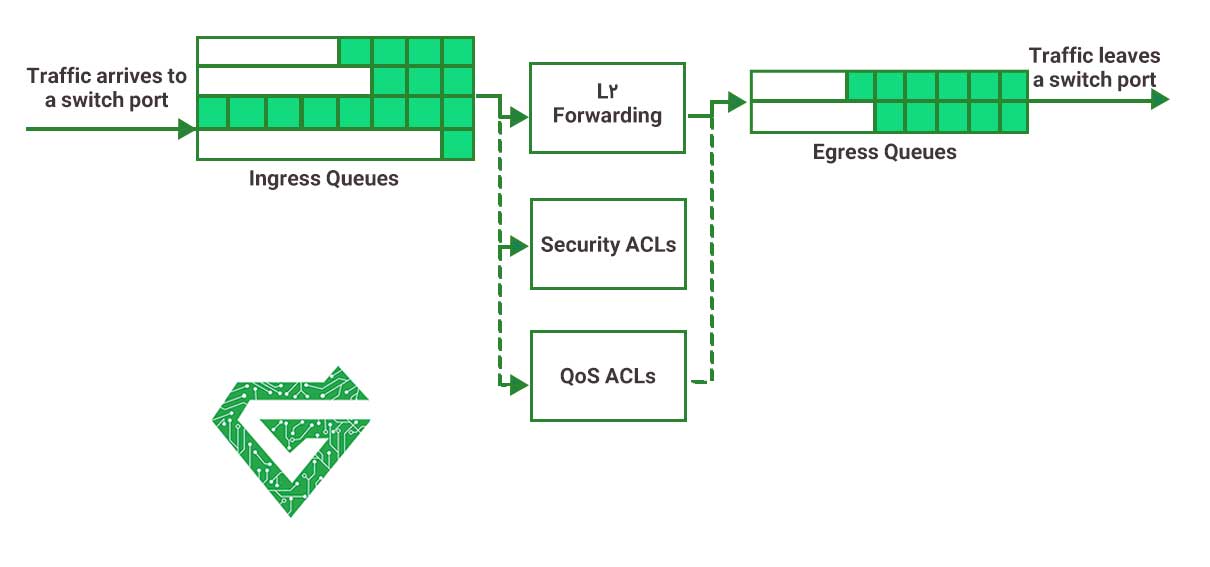
When a switch receives a frame, put the frame into the enter raw. One port can have multiple ingress queues, normally these raw use for service frame differently. When switches choose a frame from the raw to transmit, they have to answer some questions;
- Where should the frame forward to?
- Are there any preventing of forwarding the frame?
- Is there any prioritization or marking that needs to apply on the frame?
- MAC address Forwarding: To figure out where a frame must be sent, the switch will look up its MAC address table. This information can be told to the switch or it can learn it automatically. The switch listens to incoming frames and checks the source MAC addresses. If the address is not in the table already, the MAC address, switch port, and VLAN will then get recorded in the forwarding table. The forwarding table is also called the CAM table.
What happens if the destination MAC address of the frame is unknown to the switch? The switch then forwards the frame through all ports within a VLAN except the port the frame was received on. This is known as unknown unicast flooding. Broadcast and multicast traffic is destined for multiple destinations, so it will get flooded by default.
- Layer 2 forwarding: We call layer 2 forwarding also MAC address that includes some information about where to forward the frame. Specially the layer 2 table includes MAC address and destination ports. The switches demonstrate the destination MAC address of the incoming frame in the MAC table and forward the frames to the destination ports that is clear in the table. If the MAC address is not found, the frame is fired through all ports in the same VLAN.
- ACL: ACL is the contraction of Access Control Lists, that don’t only apply to routers. Switches can apply it based on MAC address and IP address. Totally just the higher-level switches support ACLs based on both MAC address and IP address, whiles in layer 2 switches support the ACLs only with MAC address.
- QOS: We can classify incoming frames according QoS parameters, then you be able to marked, prioritized and rate-limited the traffic.
CAM and TCAM:
Switches use specialized hardware to set the MAC table, ACL lookup data, and QoS lookup data. For the MAC table, switches use content-addressable memory (CAM), whereas the ACL and QoS tables are set in ternary content-addressable memory (TCAM). Both CAM and TCAM are extremely fast access and allow for line-rate switch performance. CAM supports only two results: 0 or 1. Therefore, CAM is useful for Layer 2 forwarding tables.
TCAM shows three results: 0, 1, and don’t care. TCAM is most useful for building tables for searching on longest matches, such as IP routing tables organized by IP prefixes. The TCAM table stores ACL, QoS, and other information normally associated with upper-layer processing. As a result of using TCAM, applying ACLs does not affect the switch performance.
Layer 3 or multilayer operation:
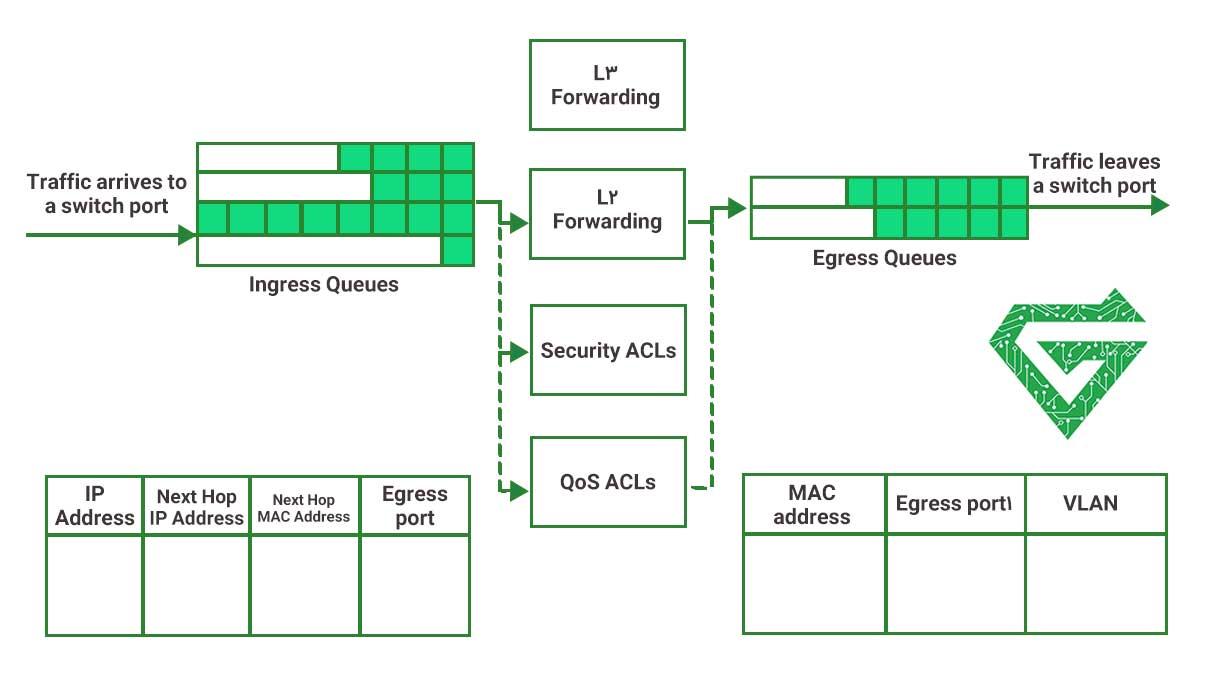
Multilayer switches can perform of layer 2 switching task, also can forward frames based on layer 3 and layer 4. They can combine switch performance and router performance together and adding a flow cache either. Multilayer switches apply the same haviour of layer 2 and adding an extra parallel searching for how to rout a packet.
Differences between layer 2 and layer 3 switches:
The associated table for layer 3 lookup is called FIB table. The FIB table doesn’t contain only egress ports and VLAN information, It has also MAC rewrite information. The ACL and QoS parallel lookups happen the same as Layer 2 switches, except there may be additional support for Layer 3 ACLs and QoS prioritization.
For example, a Layer 2 switch probably be able to apply to rate-limiting frames based on source or destination MAC addresses, whereas a multilayer switch generally supports rate-limiting frames on IP/MAC addresses.
Unfortunately, different models of Cisco switches support different capabilities, and some Layer 2 switches actually support Layer 3 ACLs and QoS lookups. For the purpose of CCNP Switch, Layer 2 switches support ACLs and QoS based on MAC addresses, whereas Layer 3 switches support ACLs and QoS based on IP or MAC addresses.
Cisco Switching Methods:
Cisco switching methods describes the route processor behavior found on Cisco IOS routers. Because multilayer switches are capable of routing and in fact, contain a routing process, a review of these concepts is necessary.
A Cisco IOS-based router uses one of three methods to forward packets: process switching, fast switching, and Cisco Express Forwarding (CEF).
Recall from your study of routers that process switching is thFe slowest form of routing because the router processor must route and rewrite using software. Because speed and the number of cores limit the route processor. This method does not scale.
The second method, fast switching, is a faster method by which the first packet in a flow is routed and rewritten by a route processor using software, and each subsequent packet is then handled by hardware. The CEF method uses hardware forwarding tables for most common traffic flows, with only a few exceptions. If you use CEF, the route processor spends its cycles mostly on other tasks.
The architecture of the Cisco Catalyst and Nexus switches both focus primarily on the Cisco router equivalents of CEF. The absolute last-resort switching method for Cisco Catalyst or Nexus switches is process switching. The route processors of these switches were never designed to switch or route packets, and by doing so, this will have an adverse effect on switch performance. Fortunately, the default behavior of these switches is to use fast switching or CEF, and process switching occurs only when necessary.
With Cisco Catalyst switching terminology, fast switching is referred to as route caching, and the application of CEF with distributed hardware forwarding is referred to as topology-based switching.
As a review, the following list summarizes route caching and topology-based forwarding on Cisco Catalyst switches:
Route caching: Also known as flow-based or demand-based switching, route caching describes a Layer 3 route cache that is built within the hardware functions as the switch detects traffic flow into the switch. This method is functionally equivalent to fast switching in Cisco IOS Software.
Topology-based switching: Information from the routing table is used to populate the route cache, regardless of traffic flow. The populated route cache is the FIB, and CEF is the facility that builds the FIB. This method is functionally equivalent to CEF in Cisco IOS Software.