


Enhanced Interior Gateway Routing Protocol (EIGRP)


The Enhanced Interior Gateway Routing Protocol (EIGRP) is an advanced distance-vector routing protocol developed by Cisco Systems. It’s designed to manage the routing of IP packets within an autonomous system (AS) and is known for its fast convergence, scalability, and efficient use of bandwidth.
EIGRP Protocol combines the simplicity of distance-vector protocols with certain link-state features, using the Diffusing Update Algorithm (DUAL) to guarantee loop-free and efficient paths. It supports multiple network layer protocols (IPv4, IPv6, IPX, AppleTalk), but in modern networks, it’s primarily used for IPv4 and IPv6.
EIGRP is classless, supports variable-length subnet masking (VLSM), and can automatically summarize routes. It communicates using multicast packets (224.0.0.10 for IPv4) and maintains neighbor relationships to exchange routing information only when changes occur, making it more efficient than traditional distance-vector protocols like RIP.
Enhanced Interior Gateway Routing Protocol (EIGRP):
The Enhanced Interior Gateway Routing Protocol (EIGRP) is a dynamic routing protocol developed by Cisco to efficiently exchange routing information within an autonomous system. It’s often described as a hybrid protocol because it combines features of distance-vector and link-state protocols, providing fast convergence and efficient resource usage.
EIGRP Protocol uses the Diffusing Update Algorithm (DUAL) to calculate the best loop-free paths to destinations and can maintain backup routes for quick failover. It supports IPv4 and IPv6, is classless (supports VLSM and CIDR), and sends routing updates only when network changes occur, reducing unnecessary bandwidth usage.
While it is optimized for Cisco devices and works very well in enterprise networks, it is less common in large multi-vendor environments because it remains largely Cisco-proprietary.
How EIGRP works?
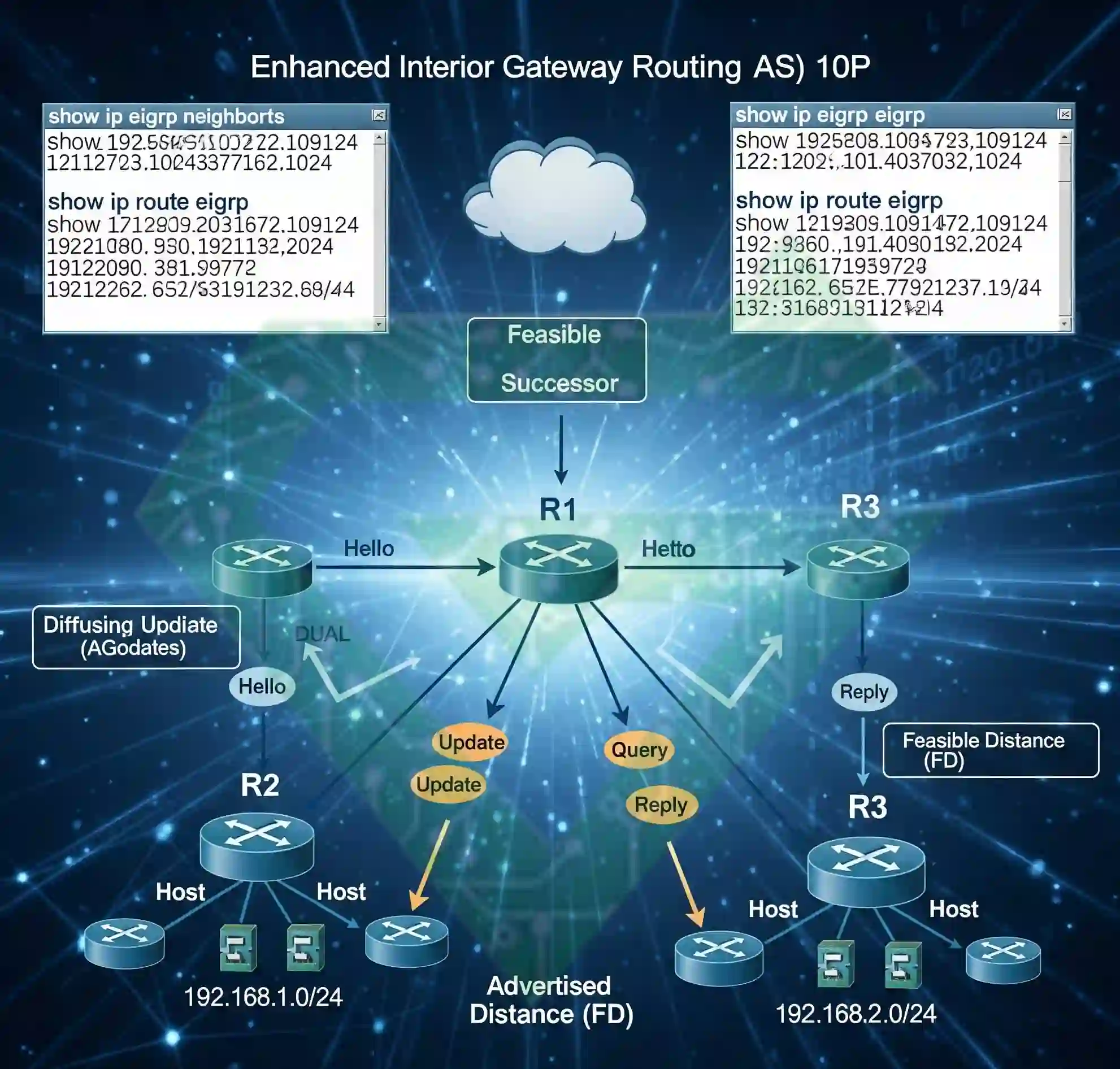
EIGRP works by establishing neighbor relationships and exchanging routing information only when necessary, which makes it both fast and efficient. First, routers running EIGRP use Hello packets to discover other EIGRP enabled routers directly connected to them. These Hello messages are sent to a special multicast address (224.0.0.10 for IPv4), and when two routers agree on parameters like the autonomous system number and metric settings, they become neighbors. This neighbor relationship is important because EIGRP only exchanges routing updates with established neighbors, reducing unnecessary network traffic.
Once neighbors are formed, EIGRP shares its known routes during the initial exchange. Unlike older protocols that send the full routing table periodically, EIGRP sends full updates only once and then transmits incremental updates only when changes occur in the network. These updates are sent reliably to neighbors, ensuring accuracy while saving bandwidth. Each router builds a topology table, which contains all routes learned from its neighbors, including both the best and potential backup paths.
EIGRP uses the Diffusing Update Algorithm (DUAL) to choose the best path to each destination, called the successor. This selection is based on a composite metric that typically considers bandwidth and delay, though other factors like reliability and load can be included. If an alternate path meets certain conditions, it is stored as a feasible successor, which can instantly replace the main route if it fails. If no feasible successor exists, EIGRP queries its neighbors for an alternative route, ensuring that any new path chosen is loop-free. This approach allows EIGRP to achieve fast convergence while avoiding routing loops.
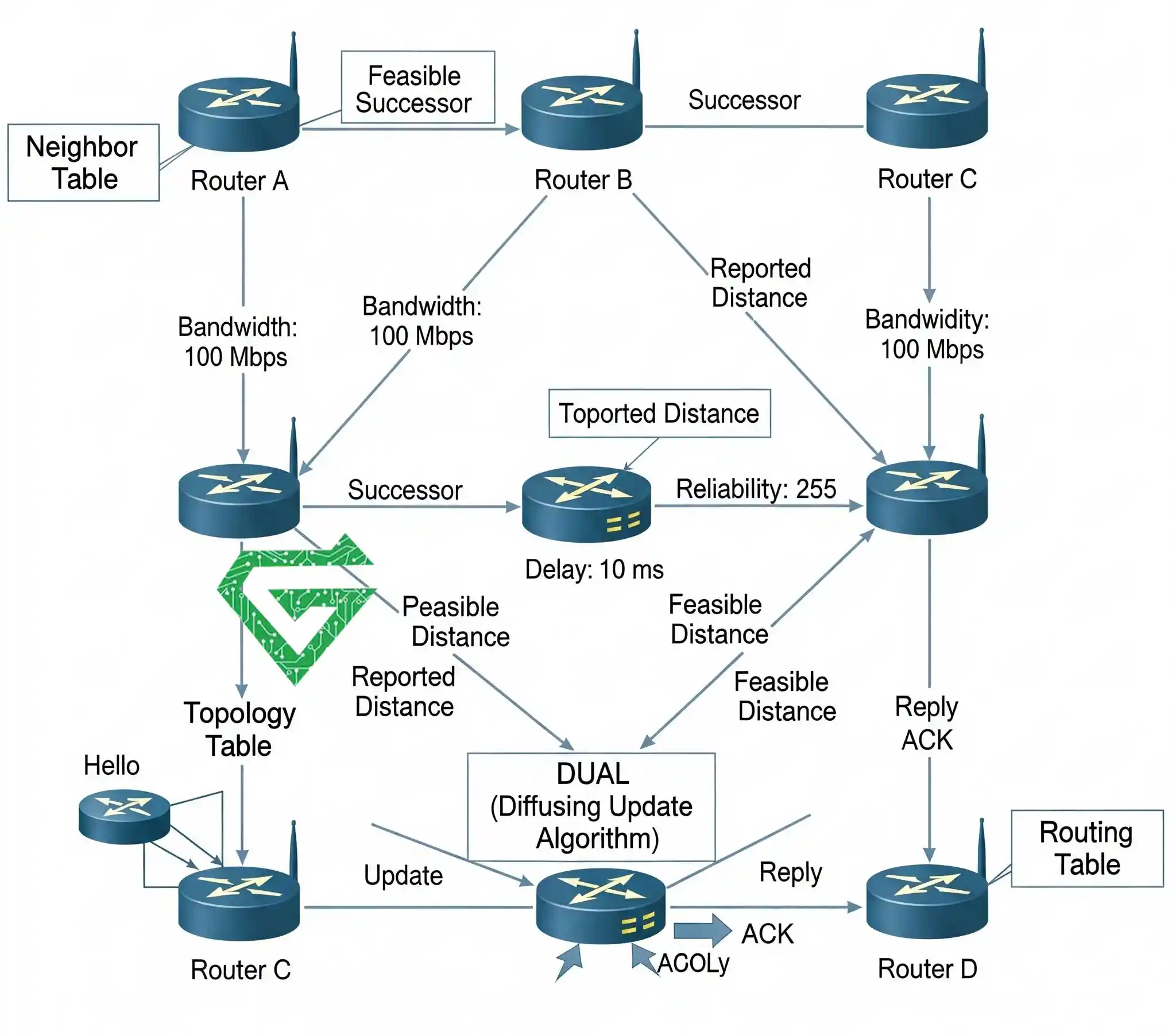
What network equipment have EIGRP Protocol?
EIGRP is primarily a Cisco proprietary protocol, so it’s mostly found on Cisco network equipment. Non-Cisco vendors generally do not support EIGRP natively because it’s proprietary, though there are a few exceptions with limited implementations or proprietary licensing.
- Cisco Routers: Almost all Cisco routers support EIGRP.
- Cisco Layer 3 Switches: Many Cisco multilayer switches that perform routing support EIGRP.
- Cisco Firewalls: Some Cisco firewalls with routing capabilities support EIGRP.
Read more: What is BGP and Why Is It Critical for the Internet
Concept of EIGRP Protocol:
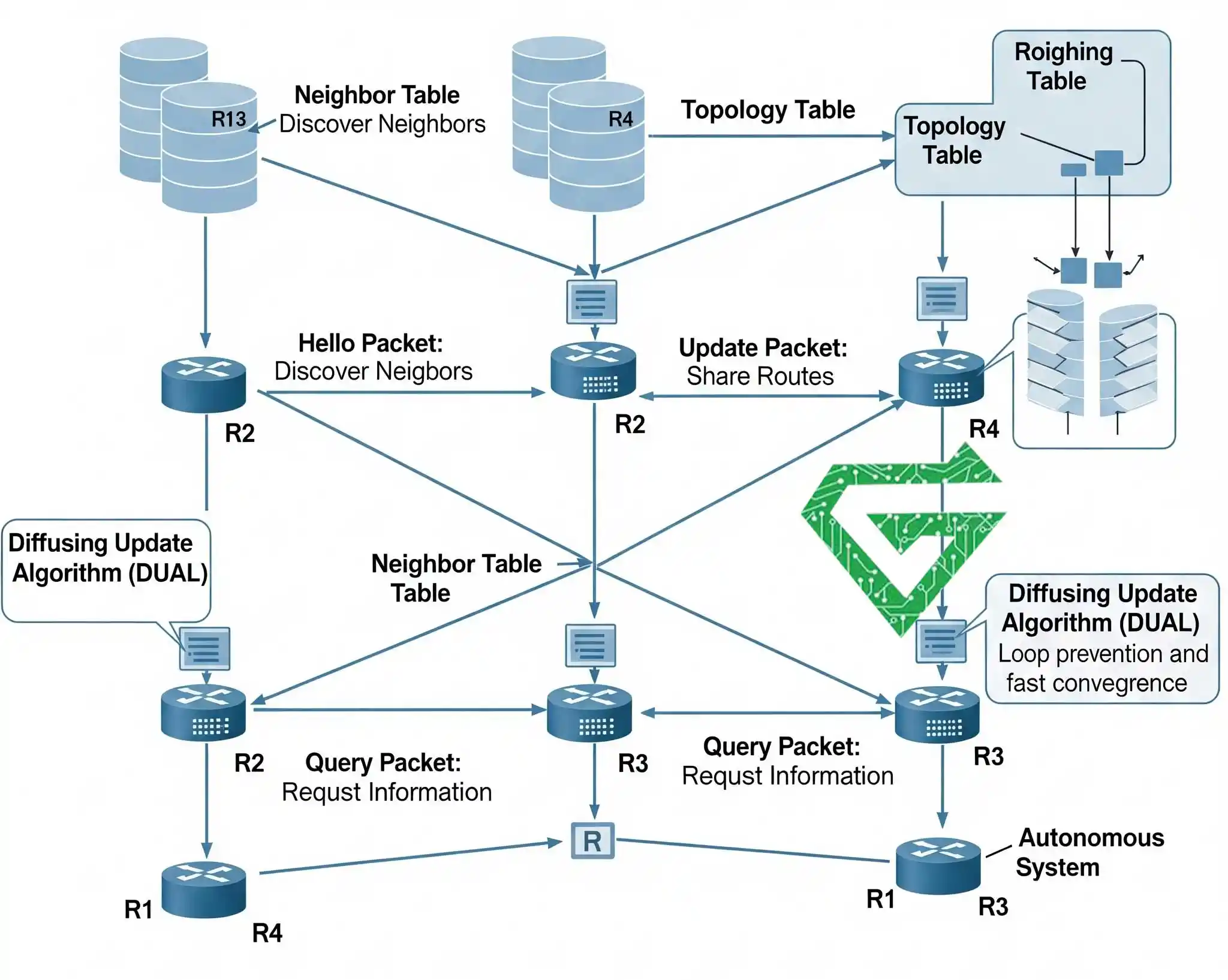
The concept of EIGRP is centered on allowing routers within the same autonomous system to share routing information quickly and efficiently while preventing routing loops. It’s considered an advanced distance-vector protocol because it blends the neighbor-based simplicity of distance-vector protocols with certain topology awareness features of link-state protocols. EIGRP’s operation revolves around three main elements:
- Neighbor Table: Tracks directly connected routers running EIGRP, discovered via Hello packets.
- Topology Table: Stores all routes learned from neighbors, including their metrics, and keeps both the best (successor) and backup (feasible successor) routes.
- Routing Table: Contains only the best available routes chosen from the topology table by the DUAL algorithm.
At its core, EIGRP uses the Diffusing Update Algorithm (DUAL) to calculate loop-free paths and ensure quick convergence. Updates are sent only when network changes occur, using multicast to conserve bandwidth. Metrics are calculated mainly using bandwidth and delay, though reliability and load can also be considered. This approach makes EIGRP fast, efficient, and scalable, particularly in Cisco-based enterprise networks.
Types of EIGRP Protocol:
EIGRP itself is a single routing protocol, but it can operate in different types or modes depending on the network layer protocol it’s routing and the way it’s implemented. These types are more like “flavors” of EIGRP rather than completely different protocols.
- EIGRP for IPv4: This is the most widely used form of EIGRP, designed to route IPv4 traffic. It uses the multicast address 224.0.0.10 for neighbor communication and operates within an autonomous system. All the concepts of neighbors, topology tables, DUAL, and metrics apply here.
- EIGRP for IPv6: EIGRP was later adapted to support IPv6 routing. Instead of 224.0.0.10, it uses the IPv6 multicast address FF02::A for neighbor discovery and updates. One notable difference is that in IPv6, EIGRP must be enabled per interface rather than globally with a “network” command.
- EIGRP Named Mode: This is not a different protocol version but a modern configuration style introduced by Cisco. Instead of creating separate configurations for IPv4 and IPv6, you configure EIGRP under a single “named” instance, which can contain multiple address families (IPv4, IPv6). This approach makes configuration cleaner and easier to manage, especially in dual-stack networks.
- EIGRP for Other Protocols (Legacy): Historically, EIGRP supported other protocols like IPX and AppleTalk, but these are now obsolete. They followed the same operational logic but routed different protocol traffic.
Advantages of EIGRP Protocol:
- Fast convergence thanks to DUAL, which recalculates routes quickly when topology changes.
- Efficient bandwidth usage since updates are sent only when changes occur (not periodic full updates).
- Supports unequal-cost load balancing, allowing more flexible traffic distribution.
- Classless protocol with full support for VLSM and CIDR.
- Low CPU and memory usage compared to many link-state protocols.
- Scalable for both small and large enterprise networks.
- Supports multiple routed protocols (IPv4, IPv6 in modern deployments).
- Automatic route summarization (can be disabled if needed).
Disadvantages of EIGRP Protocol:
- Proprietary to Cisco (though basic support is available on some non-Cisco devices since 2013, full features still Cisco-only).
- Not ideal for very large multi-vendor networks due to limited interoperability.
- Complex configuration compared to RIP (though simpler than OSPF for some admins).
- Requires careful design to avoid suboptimal routing when using summarization.
- Less standardized than OSPF or IS-IS, making it less common in service-provider environments.
Read more: What is Firmware?
Example of EIGRP Protocol:
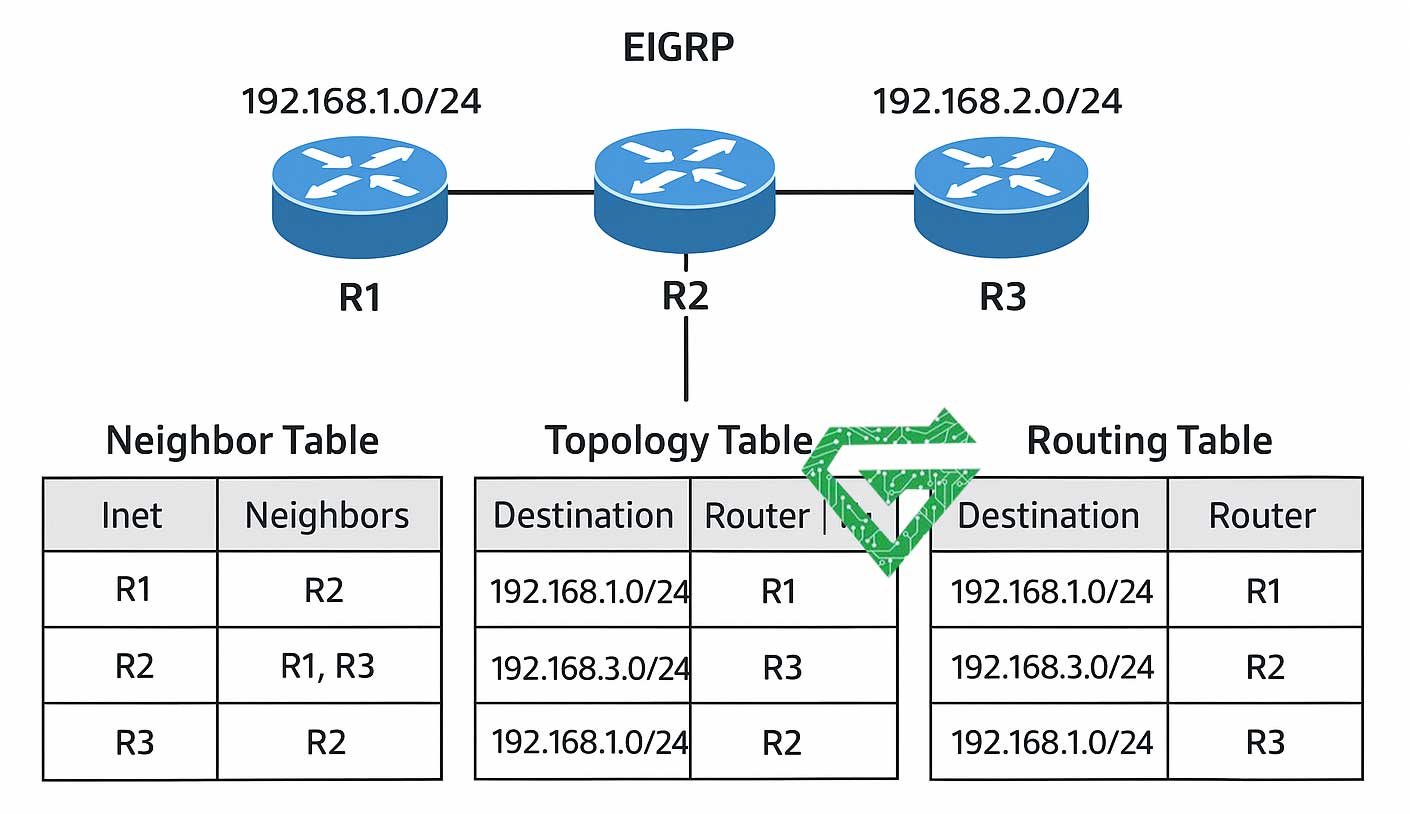
R1 —- R2 —- R3
R1 has network 192.168.1.0/24
R2 has network 192.168.2.0/24
R3 has network 192.168.3.0/24
Neighbor Discovery
- R1 sends Hello packets to R2, and R2 does the same.
- R2 sends Hello packets to R3, and they form a neighbor relationship.
- Now R1 knows R2 is its neighbor, and R3 knows R2 is its neighbor.
Exchange of Routes
- R1 tells R2: “I can reach 192.168.1.0/24.”
- R3 tells R2: “I can reach 192.168.3.0/24.”
- R2 passes this information along so R1 learns about 192.168.3.0/24 via R2, and R3 learns about 192.168.1.0/24 via R2.
Topology Table Update
- Each router stores the new routes in its topology table, including metrics (bandwidth + delay).
- The best route is marked as the successor and placed in the routing table.
DUAL and Backup Routes
- If R2 also had another link to R3 (say, a direct R1–R3 link), EIGRP could store that as a feasible successor a backup route for instant failover.
Failure Handling
- If the R2–R3 link fails, DUAL immediately switches R1’s traffic to the backup path via the direct R1–R3 link without needing a full network recalculation, avoiding downtime.
Conclusion:
EIGRP is a fast, efficient, and scalable advanced distance-vector routing protocol developed by Cisco. It combines the benefits of both distance-vector and link-state protocols, providing rapid convergence, loop-free routing, and support for multiple network layer protocols. EIGRP uses the Diffusing Update Algorithm (DUAL) to calculate the shortest path and minimize routing updates, which helps reduce bandwidth usage and CPU load.
It is well-suited for large and complex enterprise networks due to its flexibility, ease of configuration, and strong support for unequal-cost load balancing. We explained EIGRP Protocol in this article, you can read other our blogs in Atech Blog. Atech.ae actives in network equipment selling and provides your necessaries in network in high quality with affordable price. For more information contact us.